Eye-Catching Statistics
- 83% of MD kindergarteners are "fully school ready" which means 17% are not. (Data from 2011-2012) Fully School Ready means that the kiddos consistently demonstrate the skills, behaviors, and abilities which are needed to meet kindergarten expectations successfully.
- 78% of Washington county's kindergarteners are "fully school ready."
- School readiness of low-income children rose from 38% in 2001/02 to 70% in 2011/12.
- According to 1992 data from RAND, 90% of a child's brain is developed by the time they're 5 years old but 90% of public spending (investing) in children's cognitive development occurs between age 5 - 18.
The following phrases were mentioned and talked about during the day but I would have appreciate more details.
- What is the common core?
- What are the different levels of literacy?
- What is the klout score?
One of the very first observations I made on Friday was that it's clear that childhood literacy is not a one sided issue; it's more like a triangle. So, what I kept wondering throughout the day was, where are the stats on parent readiness and teacher readiness? There was a whole presentation and a half on school readiness - which focused on how prepared the kiddos are for school (kindergarten specifically) but there wasn't any assessment data shown that indicate how prepared teachers are to receive and help these kids develop; nor was there data to indicate how prepared parents are to help these kids develop.
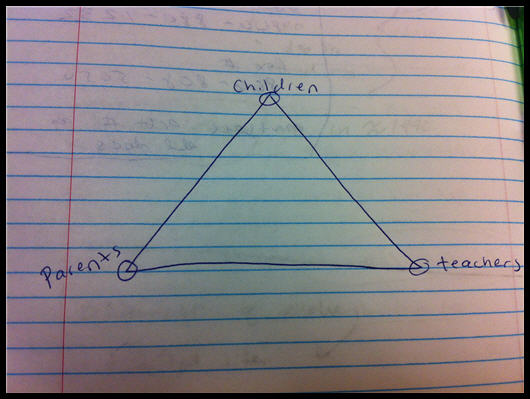 |
| My very amateur rendition of the literacy cycle |
On that note, another observation I made during the day is that there seems to be a negative connotation that comes along with being illiterate. And we wonder why folks who are illiterate aren't so quick to raise their hand and say, "yes, that's me, I can't read!" This makes me think that another area in need of improvement is to lessen the stigma associated with illiteracy and exercise some compassion when attempting to reach out to our neighbors whom the rest of us reading-folk label as "illiterate." I don't believe that the illiterate population is choosing not to learn how to read just to spite the rest of us so, why do we take it so personally? To really fan the flames on this discussion, might I point out several adults I know who have told me that they don't want to learn how to use a computer, email, cell phone, etc. Aren't they choosing to be technologically illiterate? Or how about the folks who, "only learn what they have to in order to do the bare minimum," in regards to computers? I'd say that sounds like a funcational technologically illiterate mindset, wouldn't you?
The last observation I'll share with you is one that I tried to voice during the morning debrief but that I'm not sure I expressed myself clearly.
Basically, I believe that literacy itself is changing. I'm not saying that how we are defining literacy is changing (even though we are or at least we're trying to) but that literacy is organically evolving into something else that we have no control over and that I believe we are not prepared for.
For instance, the English language is evolving - in 2011 the Oxford English Dictionary added OMG, LOL, and FYI to its pages. So, when one of Friday's presenters told a story of how a student turned in a term paper written solely in text-speak I thought, "how creative!" But that obviously wasn't how the teacher received the paper. Now, I don't know what the topic was and I don't know what the criteria was for the paper so, I'm purely reacting based on how fun it must have been for that student to write that paper and I'm also thinking of different contexts when I would think that writing in text-speak would be completely appropriate and creative (creative writing course, communications course, etc).
Literacy is based on language, right? So, if d language is changing (evolving) is it fair 4 us 2 say that individuals who write n text-speak (aka use an expanded vocabulary) r not enhancing their literacy bt degrading it? I dsagre. D mor waz we knw h2 comnc8, d btr - IMHO. Tru, contxt plays a big pt n der r vry wel tyms wen text-speak prolly isn't suitable accrdng 2 societal norms bt I bleev that will chng n tym.
If you consider yourself text-speak illiterate, that's ok! Join the crowd. There are free tools to help you such as Lingo2Word.
To tie in one last point with my "text-speak is helping the English language to evolve" argument, I'd like to say that this isn't the first time the language has adopted abbreviated version of its vernacular. Just look at the differences between British English and American English. We dropped Her Majesty's u's in behaviour, saviour, paviour, and favour, etc. We also dropped the s in towards, forwards, and rightwards. American English also shortened British phrases like skimmed milk (we say skim milk), dolls' house (we say dollhouse); barber's shop (we say barbershop).
Hmm, something just occurred to me. Maybe text-speak is the next version of Pidgin English?! See, if we pay attention we can experience the creation of a new language. How often does that happen? All we have to do is open our minds to the experience and incorporate it into what we already know about teaching language and literacy.
thx 4 rdng! :) LOL
